
Case study · Murph
Health data needs answers, not another dashboard.
An open-source personal health AI that connects data, runs experiments, and helps friends keep each other on track.
- Role
- Product, frontend, UX, brand
- Team
- Two people
- Status
- Live, early stage
- Year
- 2026–now
01
The problem
Wearables and lab reports produce plenty of data, but little help with what to do next.
A lower sleep score does not tell you whether magnesium, sauna, or skipping late coffee will help. Most health products stop at the chart, so the user still has to decide what to try and whether it worked.
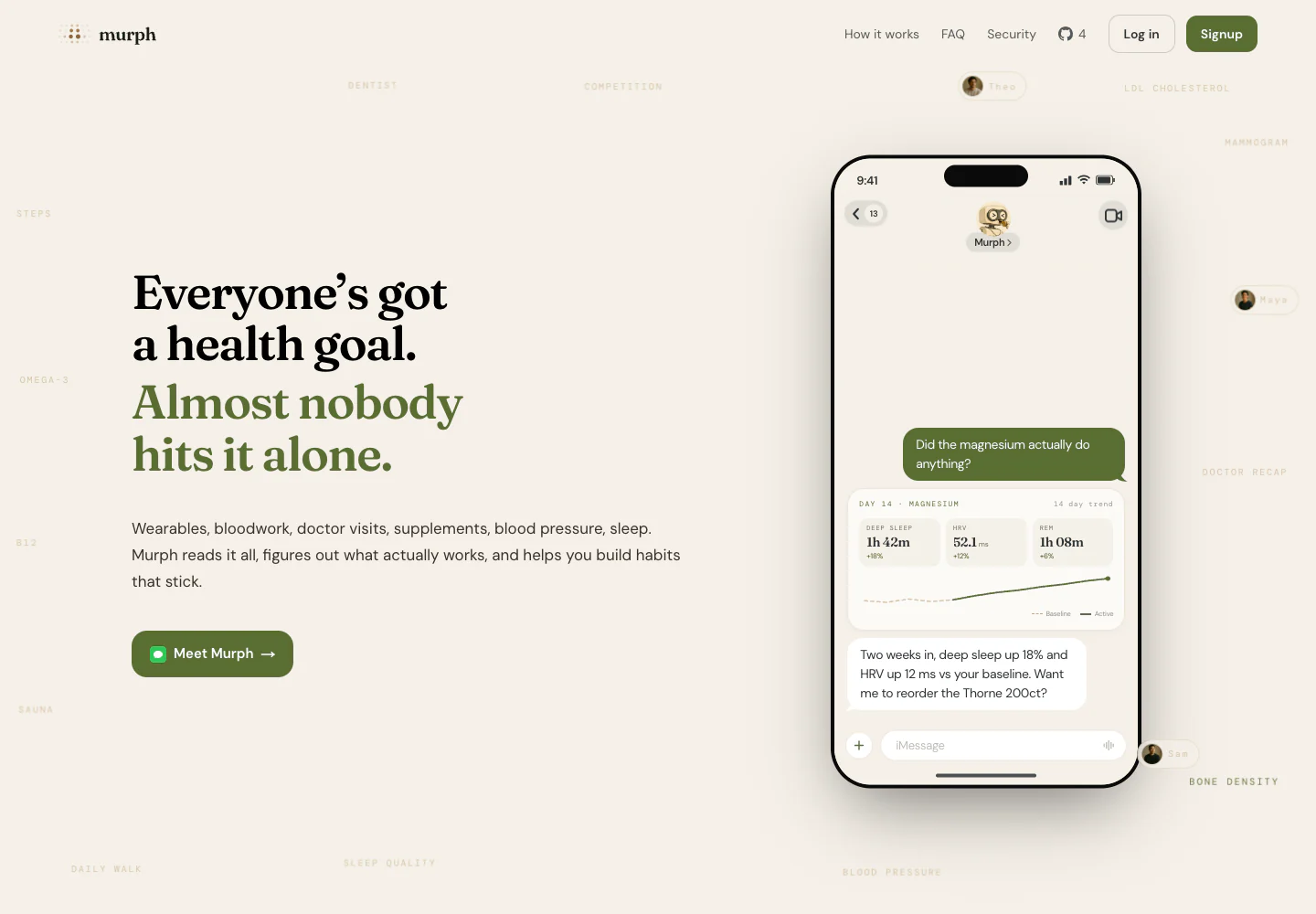
Murph turns that question into a small experiment: establish a baseline, change one thing, follow a protocol, and compare the result.
02
What it does
- Personal experiments. Establish a baseline, follow a focused protocol, and compare the before-and-after data.
- Connected context. Read wearables, labs, meals, notes, and schedules together instead of leaving them in separate apps.
- Shared motivation. Run fair challenges across different devices and send weekly recaps to friends or family.
- Follow-through. Turn a decision into a reminder, call, booking, or order, with approval before anything is bought or booked.
03
Trust as product
With health data, privacy and honest limits are product decisions.
Murph is open source under Apache 2.0 and can be self-hosted. In the hosted product, data is encrypted in transit and at rest, health data is not sold, and Murph-managed health data is not used to train general-purpose AI models.
The interface also has to show uncertainty clearly. A useful readout can suggest what to try next without claiming that noisy personal data proves cause and effect.
04
My role
I share product direction with my co-founder and build the frontend, UX, brand, and design system. AI is part of both the product and the way we make it.
I use it for market research, positioning, copy, UI exploration, icon work, and implementation. Two working documents, product.md and design.md, keep those tools tied to the same decisions and constraints.
That lets a two-person team test ideas quickly. We still decide what belongs in the product, what users can trust, and when a result is ready to ship.
05
Current state
Murph moved from the first build to beta in six weeks and reached paying customers in its first month. Since then, it has grown from personal experiments into a broader health agent with private and group chat, family updates, nutrition tools, environment reports, bookings, and calls.
The product changes quickly. The public changelog is the best record of what we are testing and shipping now.