
Case study · Cobuild
Making capital feel social.
A Farcaster mini-app that turned likes, comments, and follows into small coin purchases, then grew into a broader coordination product.
- Role
- Co-founder, product, UI/UX, frontend
- Team
- Two people
- Year
- 2025–26
- Context
- Social product, creator economy
01
The opening
Creator coins were possible, but buying one still felt like using a trading app.
We tested whether familiar social actions could make financial support easier to understand.
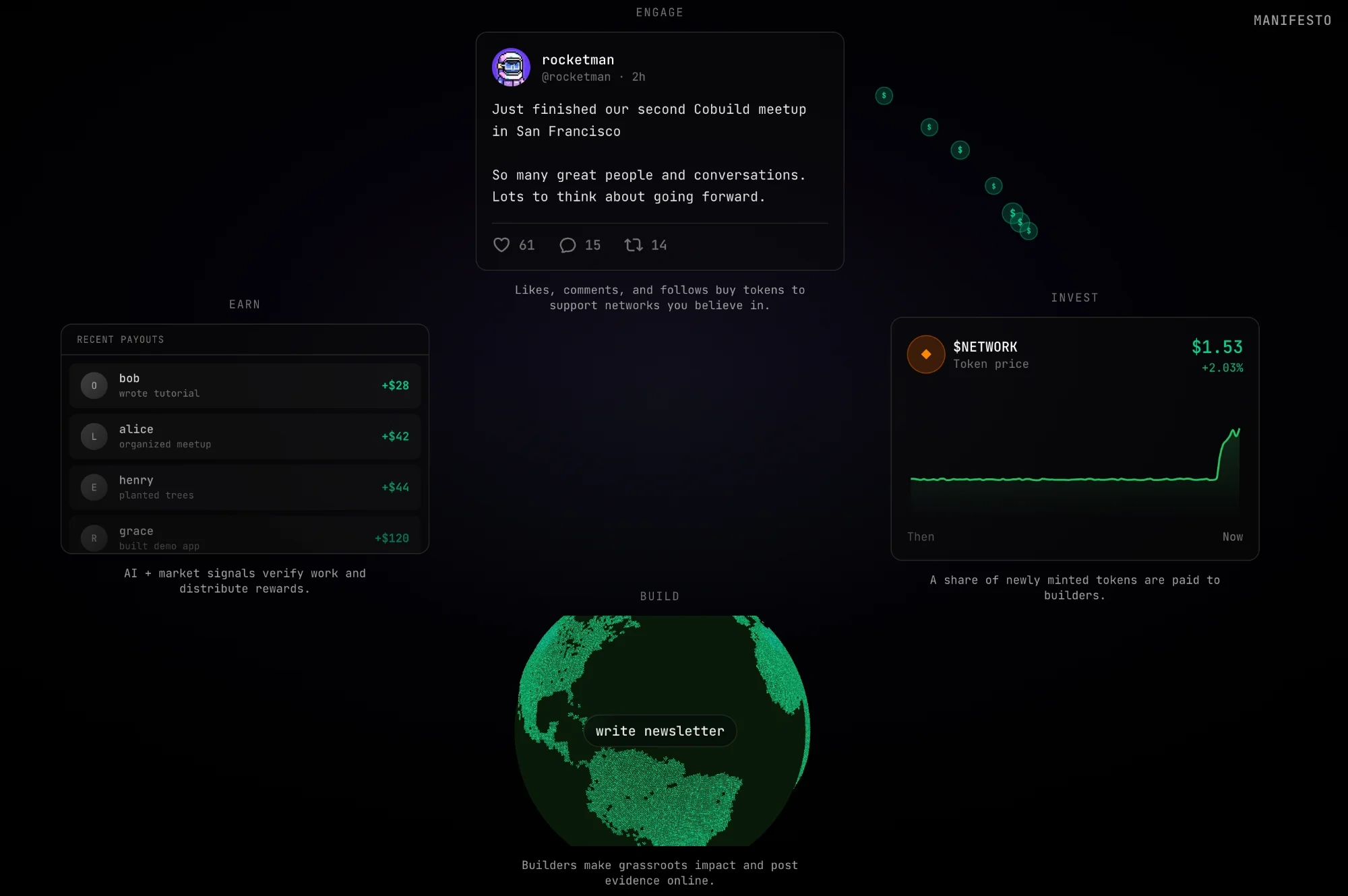
In Cobuild, likes, comments, and follows can buy small amounts of a creator’s coin. Contribution programs reward people who grow communities, while shared treasuries fund work that the network values.
02
Product decisions
- Use familiar behavior. The product built on Farcaster actions instead of teaching people a separate investment flow.
- Keep the money visible. We reduced transaction steps while making the purchase explicit and reversible.
- Reward contributions. Leaderboards and programs gave useful work a place in the economic model.
- Test the small version first. The mini-app tested distribution and behavior before we designed the larger product.
03
My role
With two people, product decisions moved straight into code.
My co-founder focused on the protocol and backend. I worked on frontend and UI/UX, then took on more implementation as Cobuild grew beyond the initial mini-app. We shaped the mechanics, roadmap, and partnerships together.
An idea discussed in the morning could be tested in the product that week. That short loop helped us learn quickly without a large team.
04
Outcome
The mini-app became a featured Farcaster app, reached a top-three usage position, and grew to around 10,000 monthly active users with more than $20k in swaps. Its traction also led to a $50k angel check from Balaji Srinivasan and gave us the evidence to design a more ambitious version of Cobuild.
05
What I learned
- Distribution shaped the product. Farcaster helped only when the product felt native to the network.
- Rewards changed behavior. Economic rules affected the experience as much as the interface did.
- Traction was not the whole market. Usage and investment did not remove timing risk, and that still affected what we chose to build next.